MID meter for an EV charger: what it is and why it matters for billing with your building
A MID meter is an electricity meter that complies with the rules on measuring instruments, so its kWh reading can be used for billing. When the charger draws power from the building’s meter or the garage owner’s meter, the MID meter shows how much your car took.
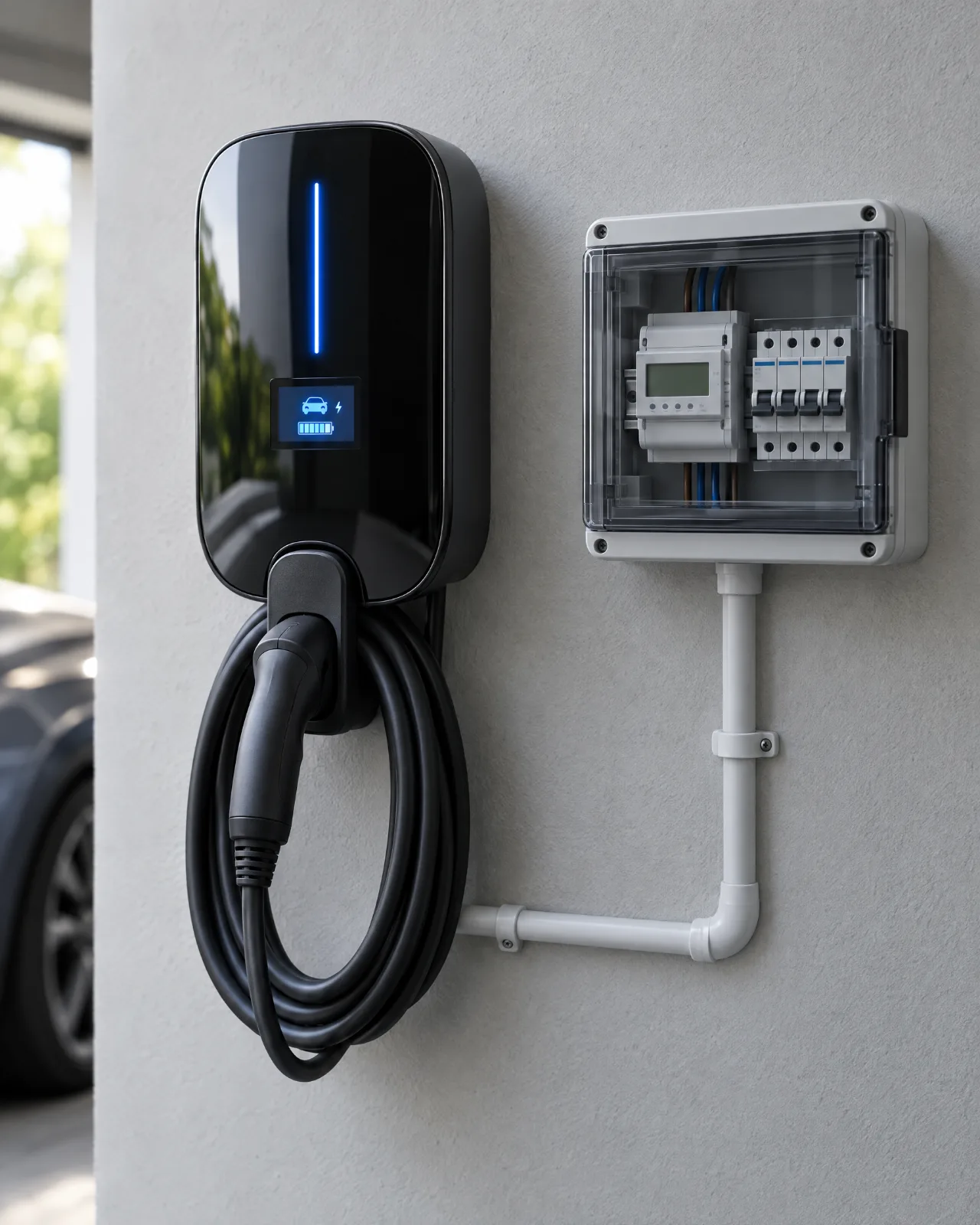
Without separate metering the cost gets split by estimate, and an estimate rarely suits every neighbor. With a MID meter each month has one kWh figure that both the building manager and you can rely on.
Below are the marks to look for, the verification interval and the questions for the residents’ assembly. To see which meter the charger could run on at your spot, go to check your garage.
What the MID mark means
MID stands for the EU Measuring Instruments Directive 2014/32/EU. Serbia covers the same area with its Rulebook on Measuring Instruments (Pravilnik o merilima), which under Article 24 is aligned with that directive.
The Rulebook covers electricity meters in Annex 5, under the code MI-003, as active electrical energy meters. The same basic rule applies to all instruments: under rated operating conditions the measurement error must not exceed the maximum permissible error.
That is what sets a MID meter apart from an estimate based on charging hours or from the figure in the car’s app. The app shows how much energy went into the battery, while the meter shows how much was taken from the grid, charging losses included.
How to recognize a MID meter
On the meter itself or on its rating plate, look for the supplementary metrology marking. Under Article 15 of the Rulebook it consists of a capital letter “M” and the last two digits of the year it was affixed, framed by a rectangle.
That marking comes directly after the conformity mark. They are followed by the identification number of the designated body, if that body took part in production control. The Rulebook requires the marks to be visible, legible and indelible.
A mark in a catalog or a quote is not enough, so check it on the device. A MID meter can be built into the wallbox or installed separately in the distribution board. Either way, a licensed electrician installs and connects it.
After installation, take a photo of the meter’s plate and its starting reading. Keep the photo with the assembly decision or the agreement with the garage owner, so everyone knows which device the billing is based on.
Why separate metering matters in a building
If the charger runs on your apartment’s meter, you pay for the electricity through your own bill and no settlement with the building is needed. If it runs on the building’s shared meter or the garage owner’s meter, the bill goes to them, so your share has to be separated.
The main meter is not the same as a MID meter for the charger. Under Article 11 of the Law on Housing and Building Maintenance, the parts of the grid in the building up to the meter, including the meter itself, are owned by the distribution system operator. The MID meter sits after the main meter and measures only the charger, for billing within the building.
The math is simple: multiply the kWh read for the month by the kWh price on the bill of the meter the charger runs on. For example, 150 kWh of overnight charging at about 6 RSD in the blue zone comes to about 900 RSD a month.
The charger also raises the consumption of the meter it runs on. Under the EPS price list applied from October 1, 2025, the green zone covers up to 350 kWh a month and the red zone starts above 1,200 kWh. How the zones change the price is explained in the guide how much a car adds to your power bill.
So write down in the agreement which kWh price the billing uses: the lower tariff, the average from the bill or another method. The electricity is paid at the price on the bill, with no markup.
Verification: how long it lasts
Electricity meters are measuring instruments under legal control. Under the Rulebook on types of measuring instruments under legal control, the periodic verification interval is 12 years for meters with direct and semi-indirect connection and 8 years for meters with indirect connection.
The interval counts from the date of conformity assessment, or from the first verification (Article 3). Meters that meet the prescribed requirements and carry the prescribed marks are not verified a first time (Article 5), so the year next to the letter “M” roughly shows when the interval started.
Whether these rules also apply to a meter used only for billing within the building is a question for a lawyer or for the Directorate of Measures and Precious Metals (DMDM). Write the answer into the assembly decision.
What the assembly should decide
Placing things in the common areas of the building and the fee for them are decided by the residents’ assembly (skupština stambene zajednice; Article 42, paragraph 1, item 16). Decisions are usually made by a simple majority of the votes of those present, while disposing of common areas takes 2/3 of all votes (Article 44). Ask a lawyer before the meeting which majority applies to a charger in your building.
The billing decision should answer a few practical questions:
- Who reads the MID meter, and on which day of the month?
- Which kWh price is used for billing, and who checks that price?
- To which account and by when do you pay your share?
- Who keeps the readings, and for how long?
- What happens to the meter when you sell the apartment or the parking space?
The outcome of the vote depends neither on you nor on the contractor. You can prepare the draft decision and the agenda item with the assembly templates.
A charger with a MID meter
Evolako installs chargers with a MID meter. START is a heavy-duty socket with a MID meter for 39,000 RSD, at 2.3–3.7 kW, which is up to about 180 km in one night. The 11 kW WALLBOX starts at 94,000 RSD, or 104,000 RSD with a MID meter. When the charger runs on someone else’s meter, it is installed only with a MID meter. All the packages are on the page packages and prices.
The subscription is optional and has no contract. With it you get a monthly statement based on the MID meter, with a report for the building or the garage owner; without it you read the meter yourself. Installation takes one working day, and with an assembly decision the whole process usually takes 4–10 weeks.
Sources
- Rulebook on Measuring Instruments (Pravilnik o merilima, Official Gazette of RS 3/2018 and amendments), Arts. 4, 15, 16 and 24, Annex 1
- Rulebook on types of measuring instruments under legal control (Official Gazette of RS 37/2021 and 84/2022), Arts. 2, 3 and 5
- Law on Housing and Building Maintenance (Official Gazette of RS 104/2016 and 9/2020), Arts. 11, 42 and 44
- EPS — price list applied from October 1, 2025
- Danas — the new electricity price list by tariff and zone from October 1, 2025
This guide was written with the help of AI tools based on the sources listed and was last checked on November 19, 2026. If you spot an error or have newer data, let us know at hello@evolako.com — we publish corrections with a date.
Charge with exact billing
Evolako START is a heavy-duty socket with a MID meter, 2.3–3.7 kW and up to about 180 km in one night, for 39,000 RSD (final price). The site check is 2,990 RSD and counts toward the installation price.
Read next
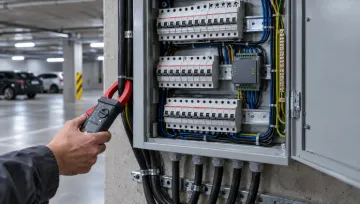
Home charging for apartment residents — installation, MID meter and billing down to the dinar.
The iPhone and Android app is coming soon.
Let me know when it’s out →
ANDREI SMEKHOV PR NOVI SAD · Katolička porta 6/3, 21000 Novi Sad · Reg. no. 68853834 · Tax ID 116047038 · Accessibility