Charging a plug-in hybrid at home: what it costs and what is enough
For most plug-in hybrids a heavy-duty socket of 2.3 to 3.7 kW on its own circuit is enough. The battery is small, so a full charge fits into the eight hours of the lower tariff and costs about 120 RSD at the night rate.
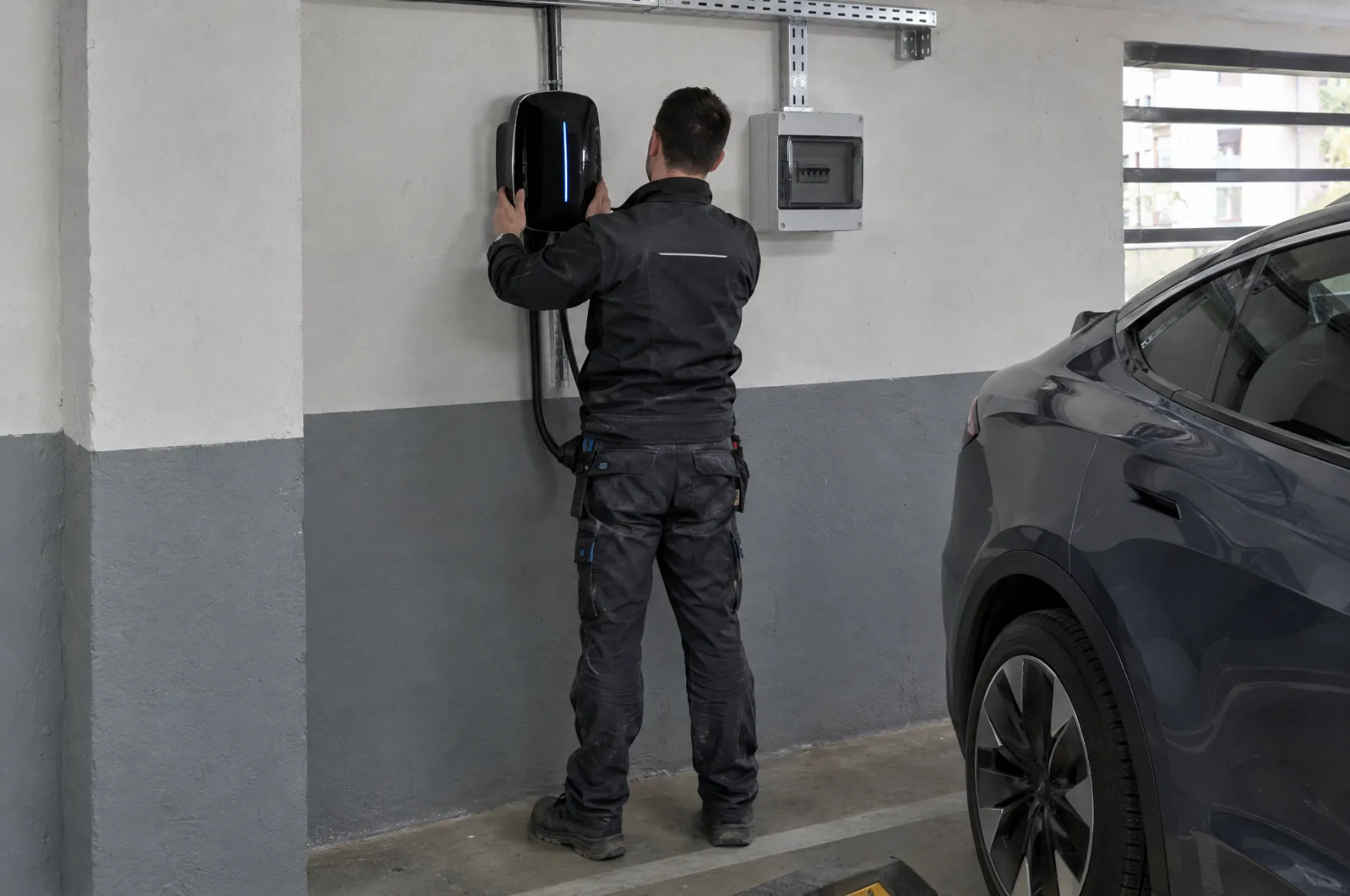
A plug-in hybrid has a battery much smaller than that of a fully electric car. So at home it does not need a strong charger, it needs a reliable spot where the car stands on the cable every night.
Before you buy anything, check what your parking spot and wiring can support. Start with the page check your garage.
How much energy it needs and how long charging takes
The 2020 Toyota RAV4 Plug-in has an 18.1 kWh battery and up to 75 km of electric driving under WLTP. The new 2026 Škoda Superb iV has a 25.7 kWh gross battery.
Carmakers say a battery like this charges overnight even from a regular socket. The RAV4 Plug-in comes with a cable for a 10 A home socket that fills the battery in 7.5 hours. For the older Superb iV and Kodiaq iV, Škoda quotes about 5 to 6 hours on a 2.3 kW socket.
The lower tariff lasts eight hours. In Belgrade it runs from midnight to 8, in Vojvodina from 23 to 7, and in central Serbia from 22 to 6. In eight hours, charging at 2.3 kW gives about 18 kWh, and at 3.7 kW about 30 kWh. That covers the battery of most plug-in hybrids.
What charging at home costs
Under the EPS price list in effect since October 1, 2025, the higher tariff in the blue zone is 14.4203 RSD per kWh and the lower one 3.6051 RSD, without excise and VAT. Energy at the lower tariff costs a quarter of the higher tariff in the same zone.
With all fees and taxes, a night kWh in the blue zone comes to about 6 RSD. If one charge draws 20 kWh from the grid, that is about 120 RSD. The same energy at the higher tariff costs several times more.
You draw more from the grid than goes into the battery. In 2026 ADAC measured losses on five electric cars: 12.7–24.2% on a 2.3 kW household socket and 5.1–7.0% on an 11 kW wallbox. Plug-in hybrids were not in the test, but the principle is the same: slow charging loses more energy.
An example for a whole month: 20 charges of 20 kWh make 400 kWh, or about 2,400 RSD at night. The tariff depends on the time of day, and the zone on the household's total use in the month. The green zone goes up to 350 kWh, so charging can easily move the bill into the blue zone. Above 1,200 kWh a month the red zone begins.
You get the lower tariff only with a dual-tariff meter. Without one, a kWh in the same zone costs the same by day and by night. Prices can change, so check the current EPS price list before you calculate.
The car's onboard charger sets the limit
The car itself converts alternating current from the socket into direct current for the battery. That onboard charger sets the highest power the car accepts. If it takes at most 3.6 kW, it will take just that from a stronger charger too.
Škoda says this openly for the older Superb iV and Kodiaq iV. The onboard charger limits power to 3.6 kW, so even a stronger wallbox will not shorten charging much. On such a wallbox Škoda quotes about 3.5 hours.
Newer cars accept more. The RAV4 Plug-in takes up to 6.6 kW and charges in about 2.5 hours on a wallbox. The new Superb iV accepts up to 11 kW of alternating current. Find the figure for your model in the technical data or the owner's manual.
What is enough: a socket, a heavy-duty socket or a wallbox
A regular household socket is for occasional charging, not for every night. ADAC does not recommend charging from a household socket for safety reasons. Charging runs for hours at full load, and old wiring may not hold up.
A heavy-duty socket on its own circuit is made for long loads and gives 2.3 to 3.7 kW. For a car with a 3.6 kW onboard charger that is practically the same speed as a wallbox. For a car with 6.6 kW or more, charging takes longer but still fits into the night.
A wallbox makes sense if the car accepts 6.6 kW or more and you need a quick top-up between two trips during the day. It also makes sense if you plan a fully electric car in the coming years, for which a night at 3.7 kW is often not enough.
A short rule: if you charge at night and do not use more than one battery a day, a heavy-duty socket is enough. You choose a wallbox for speed or for a future car, not for a small battery.
Check three things before installation
- Approved power: this is the power Elektrodistribucija approved for your metering point. If it is low, charging at 3.7 kW together with a water heater and a stove may be too much, and a licensed electrician does the load calculation.
- Meter: check whether you have a dual-tariff meter, because without one there is no cheaper night power.
- A garage in a building: a socket in a shared garage usually needs an agreement with the building manager and a decision of the residents' assembly. Ask a lawyer what kind of decision is needed and who bears the costs.
The meeting and the agreement with the neighbors are run by the building community itself, and you can download document templates for the assembly on the page register your building.
One such solution is Evolako START, a heavy-duty socket of 2.3 to 3.7 kW with a MID meter that measures how much power your own car took. Installation takes one working day, and with an assembly decision the whole process takes 4–10 weeks. All options are on the page packages and prices.
Sources
- Toyota Europe — the new RAV4 Plug-in Hybrid: battery, onboard charger and charging time, 14.09.2020
- Škoda Croatia — FAQ on the Superb iV and Kodiaq iV plug-in hybrids
- Škoda Storyboard — Superb Hatch gets a 200 kW plug-in hybrid powertrain, 27.02.2026
- ADAC — study of charging losses on a socket and a wallbox, 06.08.2026
- Danas — new electricity price list by tariff and zone from October 1, 2025
- EPS — price list in effect from October 1, 2025
- EPS — basic terms, approved power of a metering point
- N1 — How to know when power is cheap, 19.08.2026
This guide was written with the help of AI tools based on the sources listed and was last checked on November 14, 2026. If you spot an error or have newer data, let us know at hello@evolako.com — we publish corrections with a date.
Charge your hybrid every night at your own spot
Evolako START is a heavy-duty socket with a MID meter, 2.3–3.7 kW and up to about 180 km in one night, for 39,000 RSD (final price). The site check is 2,990 RSD and counts toward the installation price.
Read next
Home charging for apartment residents — installation, MID meter and billing down to the dinar.
The iPhone and Android app is coming soon.
Let me know when it’s out →
ANDREI SMEKHOV PR NOVI SAD · Katolička porta 6/3, 21000 Novi Sad · Reg. no. 68853834 · Tax ID 116047038 · Accessibility