Increasing your approved power with EDS: whether you need it and how it works
You ask Elektrodistribucija Srbije (EDS), the grid operator, for higher approved power by filing a request for a change of power. Under the Law on Energy, EDS decides within 15 days, but in the examples we found it took several months to get the new power.
In short:
- An apartment with a three-phase 17.25 kW connection plus a charger with load management — you usually don’t need an increase.
- If you do need it, you pay 1,170 RSD in fees, the amount in the EDS decision plus VAT, the electrician’s work and proof that the wiring is in order, and above 17.25 kW also a higher monthly bill.
A charger with load management lowers the charging power on its own when other appliances in the apartment use more, so even on 17.25 kW it charges your car at up to 11 kW. For everything a home installation includes, see our kits and prices.
What approved power is and where to find it
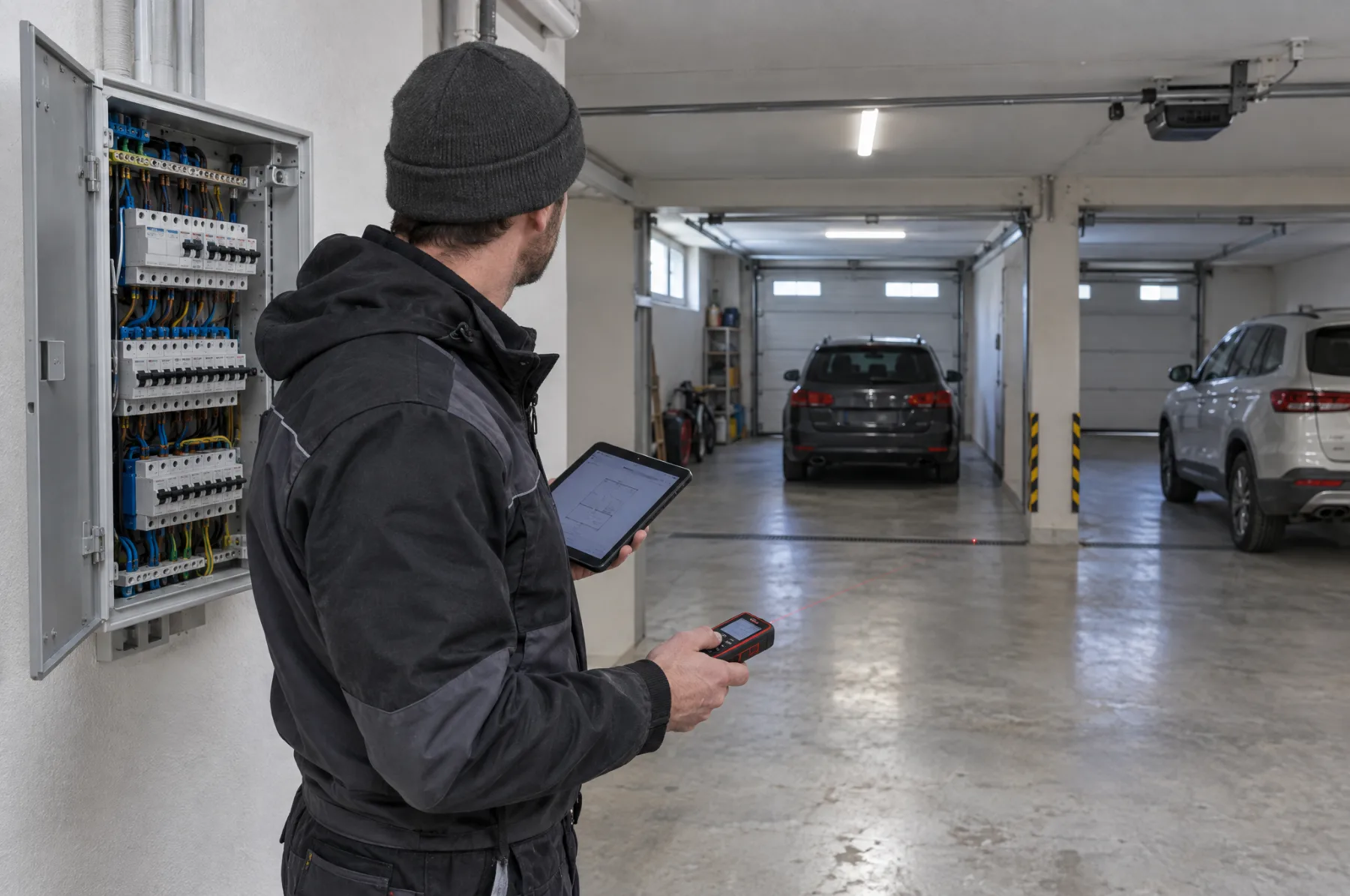
Approved power is the maximum power your metering point may draw from the grid, and it is stated in your connection decision. In the meter cabinet — the small cabinet with your meter, in apartment buildings usually in the hallway — it is limited by the main fuses or a current limiter, sealed by EDS.
- 17.25 kW (3×25 A) — the standard for a three-phase household connection.
- 11.04 kW (3×16 A) — the lowest three-phase power, with a 16 A current limiter.
- 5.75 kW (1×25 A) — a single-phase connection, common in older apartments.
If there is no connection decision, a three-phase household connection is considered approved for 17.25 kW.
Your bill comes from EPS, but power is decided by EDS. The bill shows billed power, which is not the same as approved power. Your EDS branch can tell you your approved power if you give them the ED number from your bill, and an electrician can also read it off the main fuses or the limiter.
When you don’t need an increase, and when you do
For everyday driving you usually don’t need an increase: a car that drives 30 km a day uses 5 to 6 kWh. Even single-phase charging at 3.7 kW (16 A) gives you about 150–180 km overnight, depending on the car.
On a three-phase 17.25 kW connection, an 11 kW charger takes 16 A per phase, and the apartment is left with 9 A, or about 2 kW, per phase. Load management tracks the apartment’s consumption through a current sensor in your distribution board and reduces charging when you turn on the stove or water heater, so the fuses don’t trip.
Even on 11.04 kW (3×16 A), a charger with load management usually gets a few kW at night — more than you need for 30 km a day.
An increase makes sense in three cases:
- your home runs electric heating (a heat pump with a backup heater, a storage heater or similar), a water heater and a charger at the same time, so even with load management there isn’t enough left for charging;
- you have a single-phase connection, and single-phase charging isn’t enough for you or you want three-phase appliances;
- several residents want to charge their cars in a shared garage — then the residents’ association asks for more power for the shared metering point, or for a new connection.
Above 17.25 kW, power goes up in steps set by the main fuse rating, for example 22.08 kW (3×32 A), and a standard connection goes up to 43.5 kW (3×63 A). An electrician works out how much you need from the appliances that run at the same time.
What it costs: one-time and monthly
With the request, you pay national administrative fees: 430 RSD for the request and 740 RSD for the decision, 1,170 RSD in total. These amounts apply from July 1, 2026. Check the payment details with your branch.
What you pay EDS is calculated under the methodology of the Energy Agency of the Republic of Serbia (AERS): the actual cost of the work plus a share of system costs for the approved increase in power. That amount is stated in the decision, excluding VAT, so add 20% to it.
You pay the electrician separately: the work from the meter to your distribution board and the proof that the wiring is in order.
For a rough idea, here are examples from the media and forums:
- a weekend cottage in Krčedin, switching from a single-phase to a three-phase connection, 2025: 92,731 RSD excluding VAT, or 111,277 RSD including VAT. Of the amount excluding VAT, 76,655 RSD was the connection service and about 16,000 RSD the share of system costs;
- an apartment in a building, the same switch, 2023: 55,000 RSD (not stated whether VAT is included) plus 6,000 RSD for a wiring test report, according to a forum user;
- another apartment, the same switch, 2023: about 1,000 euros to EDS and about 100 euros for testing the wiring, plus a separate repair of the wall around the new cabinet.
For an increase without switching from single- to three-phase, we did not find a publicly reported amount. There is usually less work in that case: EDS often just replaces the fuses or the current limiter if the existing service cable can handle it.
Every month your EPS bill also includes billed power — an amount per kW, on top of the electricity you use. Until December 31, 2026, a transitional rule applies to three-phase households with approved power above 11.04 kW and up to 17.25 kW. They are billed for 11.04 kW, and in a month with consumption up to 350 kWh, for 6.90 kW.
At 22.08 kW the transitional rule does not apply, and you pay for the full approved power: in a month over 350 kWh, that is 11.04 kW more than at 17.25 kW. At the price in effect since October 1, 2025 (60.8947 RSD per kW per month, excluding excise duty and VAT), that is about 670 RSD, or about 870 RSD with excise duty and VAT. In a month up to 350 kWh, the difference is even larger.
When you switch from single-phase 5.75 kW to three-phase 17.25 kW, your billed power, while the transitional rule applies, rises to 11.04 kW in a month over 350 kWh. If you’re currently billed for 5.75 kW, that is about 415 RSD more per month with excise duty and VAT — check that line on your bill.
While the transitional rule applies, going from 11.04 to 17.25 kW does not raise the billed power on your bill. Before filing, check the EPS website for what applies from January 1, 2027.
The EDS procedure, step by step
You file the request with the EDS branch responsible for your address, in person at its filing office (pisarnica) or by mail — not through the building-permit system. Ask the branch whether it also accepts requests electronically.
The 15-day deadline applies to the decision, not to the whole job. Two forum users describe five months each from request to new power (2023). In the case reported by the weekly “Vreme” in 2025, the first contact from EDS alone took three months, and the decision arrived a few days after the site visit.
Which documents to prepare
The exact list of attachments is in the form itself; usually you need:
- the completed EDS form “Zahtev za izdavanje odobrenja za priključenje za promenu snage” (request for a connection approval for a change of power), from the elektrodistribucija.rs website;
- proof of ownership, for example a land registry extract (izvod iz lista nepokretnosti) or a purchase contract;
- proof of payment of the national administrative fees;
- the ED number (metering point number) from your electricity bill;
- a power of attorney, if the owner is not submitting the request in person.
Ask the branch what the power of attorney must contain and whether the signature has to be certified by a notary. It usually lists the owner’s and the representative’s details, the property address, the ED number, the branch name and what the representative may do: submit the request, receive the decision and, if needed, file an appeal.
At the end of the procedure, EDS asks for proof that the wiring is in order, so ask the branch in advance which document it accepts and who issues it.
If you live in an apartment building and the higher power needs a new cable through the hallway or the riser between floors, work in the common areas needs a decision of the residents’ assembly (skupština stambene zajednice). Before filing, check with the building manager what is needed.
If you’re a tenant, the request is filed by the apartment’s owner, or by you with the owner’s power of attorney.
If EDS is late or you disagree with the decision
If the decision doesn’t arrive within 15 days, hand a reminder letter (urgencija) to the branch’s filing office or send it by registered mail, and keep the receipt. In it, state the request date, the case number, the ED number and the property address, and ask them to issue the decision or tell you what is missing.
You can appeal the decision to the Energy Agency of the Republic of Serbia within 15 days of the day it was delivered to you. The appeal is filed through EDS, along with a national administrative fee, and the Agency has two months to decide.
If the decision still doesn’t arrive after the reminder, or EDS rejects the request, talk to a lawyer about the next steps.
Sources
- Elektrodistribucija Srbije: connection outside the unified procedure — change of power and forms
- Decree on the Conditions of Delivery and Supply of Electricity, Articles 17–20
- Energy Agency (AERS): Methodology for determining connection costs (Official Gazette of RS 109/2015), item VII.1
- Energy Agency (AERS): filing appeals
- EPS Snabdevanje: household electricity bills explained
- Energetski portal: transitional billed-power rule until December 31, 2026 (August 25, 2025)
- EPS kalkulator: billed power price from October 1, 2025
- Kamatica: what you pay on your electricity bill — excise duty and VAT (October 13, 2021)
- Pravni portal: national administrative fee amounts from July 1, 2026
- Law on Energy, Articles 198–201 (unauthorized consumption)
- Vreme: “The pole is right next door, but getting three-phase power costs a thousand euros” (June 3, 2025)
- Forum Beobuild: switching from a single-phase to a three-phase meter in an apartment building (2023)
This guide was written with the help of AI tools based on the sources listed and was last checked on October 27, 2026. If you spot an error or have newer data, let us know at hello@evolako.com — we publish corrections with a date.
First, check whether you need an increase
During the on-site assessment we check your approved power, distribution board and cable route, and tell you whether you need an increase at all. The assessment costs 2,990 RSD and counts toward the installation price. The wallbox in our kit has a CT sensor and dynamic load management, so it adapts to the power you already have.
Read next
Home charging for apartment residents — installation, MID meter and billing down to the dinar.
The iPhone and Android app is coming soon.
Let me know when it’s out →