A neighbor charges a car from a shared socket: what the residents' association can do
The residents' association can decide who may charge a car from a shared socket, how consumption is measured and who pays for the power. Until that decision exists, all owners pay for the neighbor's charging through the bill for common consumption.
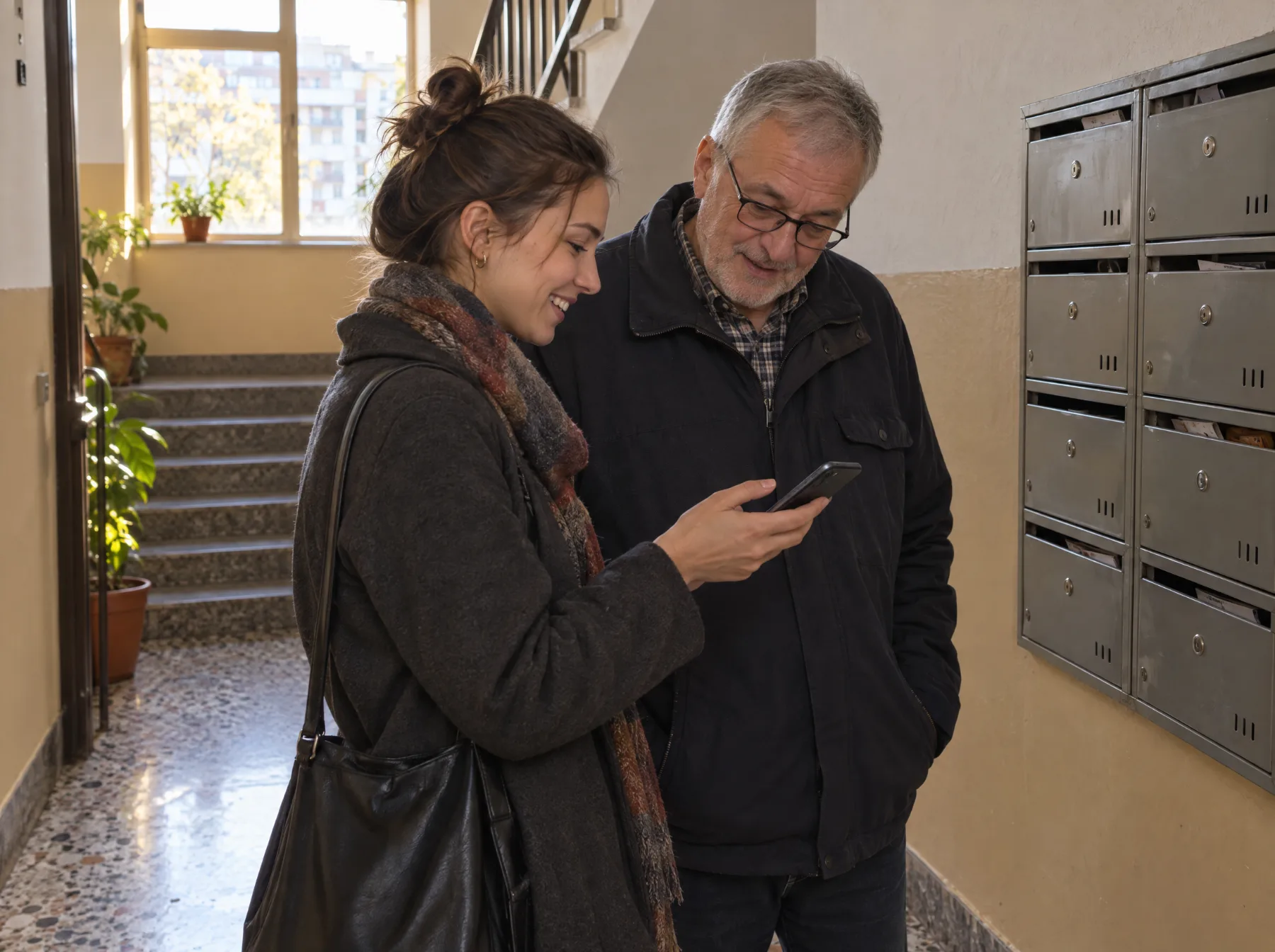
A dispute over a shared socket is rarely a dispute over the car. Usually the question is who pays for the power and who allowed the charging. Both questions have a solution that does not require a ban.
Below is what the law says, why a separate meter is the basis for a deal and how the building can agree. If you want to know whether your garage allows separate metering, first check your garage.
Everyone pays for power from a shared socket
A shared socket is most often connected to a separate meter for common consumption. EPS usually registers that meter to the residents' association and sends the bill in the name of the whole association.
The same meter measures power for hallway lighting, the elevator, the intercom, the garage and the water pumps. When a car is plugged into the socket, its kilowatt-hours go into the same bill. The cost is then split among all owners, whoever drives the electric car. The same applies when the car is parked on someone else's or a shared spot in the garage.
The difference on the bill is not small. A socket at 230 V and 10 A gives 2.3 kW. Eight hours of charging is about 18 kWh, and twenty nights a month is about 370 kWh.
The law: the assembly decides on common parts
The common parts of a building belong to all owners. Under Article 8 of the Law on Housing and Building Maintenance, owners of individual units hold the common parts in joint undivided ownership. That is why no single person decides on the use of the shared installation; the assembly does.
Article 14 obliges the owner of a unit not to hinder the use of other parts of the building through their own use. Charging on someone else's bill easily becomes exactly that kind of interference, at least in the neighbors' eyes.
Under Article 42 of the same law, the assembly decides on placing or installing items on the common parts of the building and on the fee paid by the owners of those items. A decision on charging and on a fee for the power can be based on that.
As a rule, the assembly decides by a majority of the votes of members present. For disposing of common parts, the law requires 2/3 of the total number of votes. The owners' rules can set the required majority differently.
Which majority applies in your case depends on how the decision is interpreted legally. Whether permission to charge counts as use or as disposal of a common part is a question for a lawyer, together with your building's owners' rules.
A regular socket is not made for charging every night
A shared socket in a garage is usually not designed for a load that lasts for hours. ADAC says Schuko sockets can carry their maximum current of 16 A only for a limited time. When charging lasts for hours, worn contacts or poor connections increase resistance, which can lead to overheating and fire.
That is why ADAC sees charging from a household socket as an emergency solution and advises a current of 10 A or less. Before any deal, have a licensed electrician inspect the circuit and assess whether it can handle that load. Attach the findings to the draft decision.
A MID meter: the basis for a fair statement
A separate meter settles the main dispute, which is how much power the car used. In Serbia, requirements for measuring instruments are set by the Rulebook on Measuring Instruments, harmonized with the European Directive 2014/32/EU. That directive is known by the abbreviation MID.
Annex MI-003 of the Rulebook covers active electrical energy meters. That is why both the neighbor and the other owners can rely on a MID meter reading. Without it, consumption remains an estimate, which is easy to argue about.
The statement can be simple. The building manager or another authorized person writes down the meter reading once a month. The neighbor then pays the amount into the residents' association account, at the kWh price set in the decision.
Example: if a night-rate kWh in the blue zone is about 6 RSD, a night of 18 kWh costs about 110 RSD. Before the vote, check on the common consumption bill which price actually applies.
How to reach an agreement in five steps
- Talk to your neighbor before the meeting. Show the numbers and propose metering instead of a ban, because the goal is for them to pay for their own consumption, not to stop charging.
- Ask the building manager for an agenda item. The manager calls the meeting, and you provide a short proposal of what is being adopted and why.
- Prepare a draft decision: where the socket is, who uses it, how it is metered, the kWh price, the payment deadline and who pays for the installation. Add the licensed electrician's findings.
- Vote at the meeting or by written statements outside the meeting. Minutes are kept of the assembly's work.
- Follow up on how it works. Readings and payments should be available to all owners, so trust is based on data.
A decision cannot be guaranteed in advance, but a concrete proposal with metering has a better chance than a general debate. If there is no agreement, do not draw legal conclusions yourself. An owner has the right to start court proceedings against assembly decisions; whether that applies in your case and within what deadline is a question for a lawyer.
After the decision: charging with separate metering
Once the assembly adopts the decision, the technical solution remains. Instead of a regular socket, it is a dedicated line from the distribution board to the spot, with its own protection, a reinforced socket or a wallbox, and a MID meter. Only a licensed electrician designs and installs the line.
One such solution is Evolako START, a reinforced socket with a MID meter for charging at 2.3–3.7 kW. For draft decision templates and other documents for the meeting, see the building sign-up page; the meeting and the arrangement with the manager are run by the association itself.
You can see all packages and what each includes on the packages and prices.
Sources
- Law on Housing and Building Maintenance, Articles 8, 14, 42 and 44
- Ministry — questions and answers on housing and residents' associations
- Ministry of Economy — technical regulations for measuring instruments harmonized with EU rules
- Rulebook on Measuring Instruments, Annex 5: MI-003
- Prosperitet — fees for common electricity consumption in residential buildings
- ADAC — frequently asked questions about charging an electric car
This guide was written with the help of AI tools based on the sources listed and was last checked on October 27, 2026. If you spot an error or have newer data, let us know at hello@evolako.com — we publish corrections with a date.
Metering instead of a dispute in the building
Evolako START is a reinforced socket with a MID meter, 2.3–3.7 kW and up to about 180 km in one night, for 39.000 RSD incl. VAT. For the assembly you get document templates, and the on-site assessment is 2.990 RSD and counts toward the installation price.
Read next
Home charging for apartment residents — installation, MID meter and billing down to the dinar.
The iPhone and Android app is coming soon.
Let me know when it’s out →