A home charger for a Tesla: Model 3, Model Y, Model S and Model X
The Tesla Model 3 and Model Y have a three-phase 11 kW charger, as do the Model S and Model X from 2021: on an 11 kW wallbox they use the full power. On a single-phase connection a Tesla takes up to 7.4 kW at 32 A, and on a 16 A heavy-duty socket 3.7 kW.
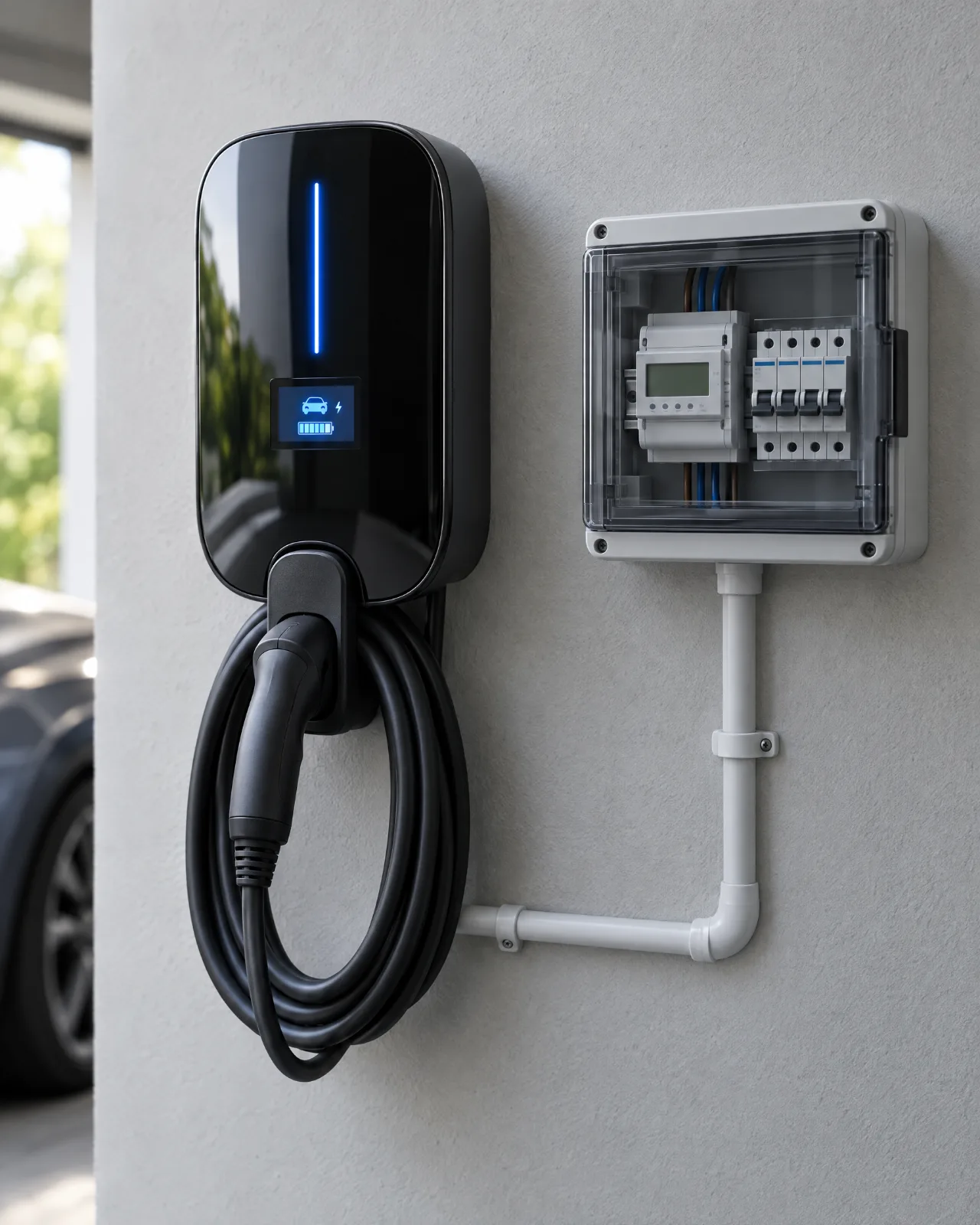
How much power a Tesla takes
A three-phase 11 kW on-board charger uses the full power of WALLBOX 11 kW. A car that accepts more than 11 kW charges at 11 kW on an 11 kW wallbox.
The Model S and Model X up to 2020 have a 16.5 kW charger (24 A per phase), and the Model S before May 2016 an 11 or 22 kW charger depending on equipment — that is what Tesla’s support pages say. On an 11 kW wallbox they all charge at 11 kW.
Tesla’s portable charger (Mobile Connector) charges at up to 3 kW (13 A) with the adapter for an ordinary socket, and at 3.7 kW with the blue 16 A adapter. For the START package you need the blue adapter.
Tesla doesn’t publish battery capacity: the figures in the table are net capacities from the ADAC catalog, and they differ by model year.
If you already have a Tesla Wall Connector, we install it: Tesla Wall Connector installation.
How long charging takes at home
The times are our own calculation for charging from 0 to 100%: battery capacity plus 10% losses, divided by the power. Charging slows down toward the end, and losses are higher on a socket (ADAC measured 12.7–24.2% at 2.3 kW and 5.1–7.0% on an 11 kW wallbox), so the real time can be longer.
START is a heavy-duty socket on its own circuit, with a MID meter: the car charges through its portable charger, at 2.3 kW (10 A) or 3.7 kW (16 A), depending on the portable charger.
What a full battery costs at night
A night kWh in the blue zone costs about 6 RSD with all fees and taxes — 5.70 RSD to be exact, under the EPS price list in force since October 1, 2025.
The price applies with a dual-tariff meter and consumption in the blue zone; in the red zone, above 1.200 kWh a month, a kWh costs more. On fast public chargers, receipts from August and September 2026 put a kWh at 43 to 79 RSD.
How much charging adds to the monthly bill is covered in the guide how much an electric car adds to your electricity bill.
Which package fits
For a Tesla we go with WALLBOX 11 kW or a Tesla Wall Connector set to 11 kW: the car uses the full power and is full in one night. START is enough for a daily top-off: Tesla gives about 24 km of range per hour of charging at 3.7 kW.
The package price is final and includes the charger and basic installation next to the distribution board: up to 2 m of cable, an RCD (FID) and a circuit breaker. If your spot is farther from the board, the cable and other work are priced at the assessment, before any work starts.
Wallbox Plus (from 115.000 RSD) and Wallbox Premium (155.000 RSD) are described under packages and prices.
Models, prices and the importer for Tesla in Serbia are in the brand overview.
FAQ
Do I need a Tesla Wall Connector, or will another wallbox do?
Any wallbox with a Type 2 cable will do: in Europe a Tesla charges through a Type 2 inlet. A Wall Connector makes sense if you already have one; either way the car takes 11 kW at most.
How fast does a Tesla charge on a single-phase connection?
Up to 7.4 kW at 32 A, according to Tesla’s page on the on-board charger. A 16 A heavy-duty socket delivers 3.7 kW; 32 A on one phase needs heavier wiring, which we check at the assessment.
How much does it cost to install a charger for a Tesla?
START is 39.000 RSD, and WALLBOX 11 kW starts at 94.000 RSD (104.000 RSD with a MID meter). The price is final and includes basic installation next to the distribution board; anything beyond that is priced after the assessment.
Sources
- Tesla — Onboard Charger (support page)
- Tesla — Wall Connector (support page)
- Tesla — Mobile Connector (support page, Slovenia)
- Tesla — Onboard Charger (support page, Australia: older Model S and Model X)
- ADAC Autokatalog — Tesla Model 3 Long Range (net capacity)
- ADAC Autokatalog — Tesla Model Y RWD (net capacity)
- ADAC Autokatalog — Tesla Model S (net capacity)
- EPS — electricity prices for guaranteed supply (from October 1, 2025)
- Household electricity prices in Serbia: zones, tariffs and levies (as of September 23, 2026)
- ADAC — study of charging losses on a socket and a wallbox
- Fast charging in Serbia: 43 to 79 dinars per kWh (September 22, 2026)
This page was written with the help of AI tools based on the sources listed, and the data were checked on November 16, 2026. If you spot an error or have newer data, let us know at hello@evolako.com — we publish corrections with a date.
A charger for your Tesla
Send photos of the distribution board and the spot for the charger — a rough estimate from photos is free, and we reply within 48 hours.
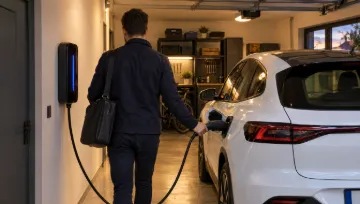
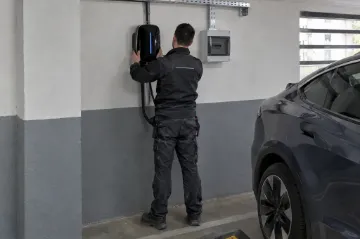
Home charging for apartment residents — installation, MID meter and billing down to the dinar.
The iPhone and Android app is coming soon.
Let me know when it’s out →
ANDREI SMEKHOV PR NOVI SAD · Katolička porta 6/3, 21000 Novi Sad · Reg. no. 68853834 · Tax ID 116047038 · Accessibility