Buying an electric car: first check where you will charge it at home
Before you buy an electric car, check three things: where the car parks at night, how much power your connection has and whose consent you need. In an apartment building this check can take longer than the car’s delivery.
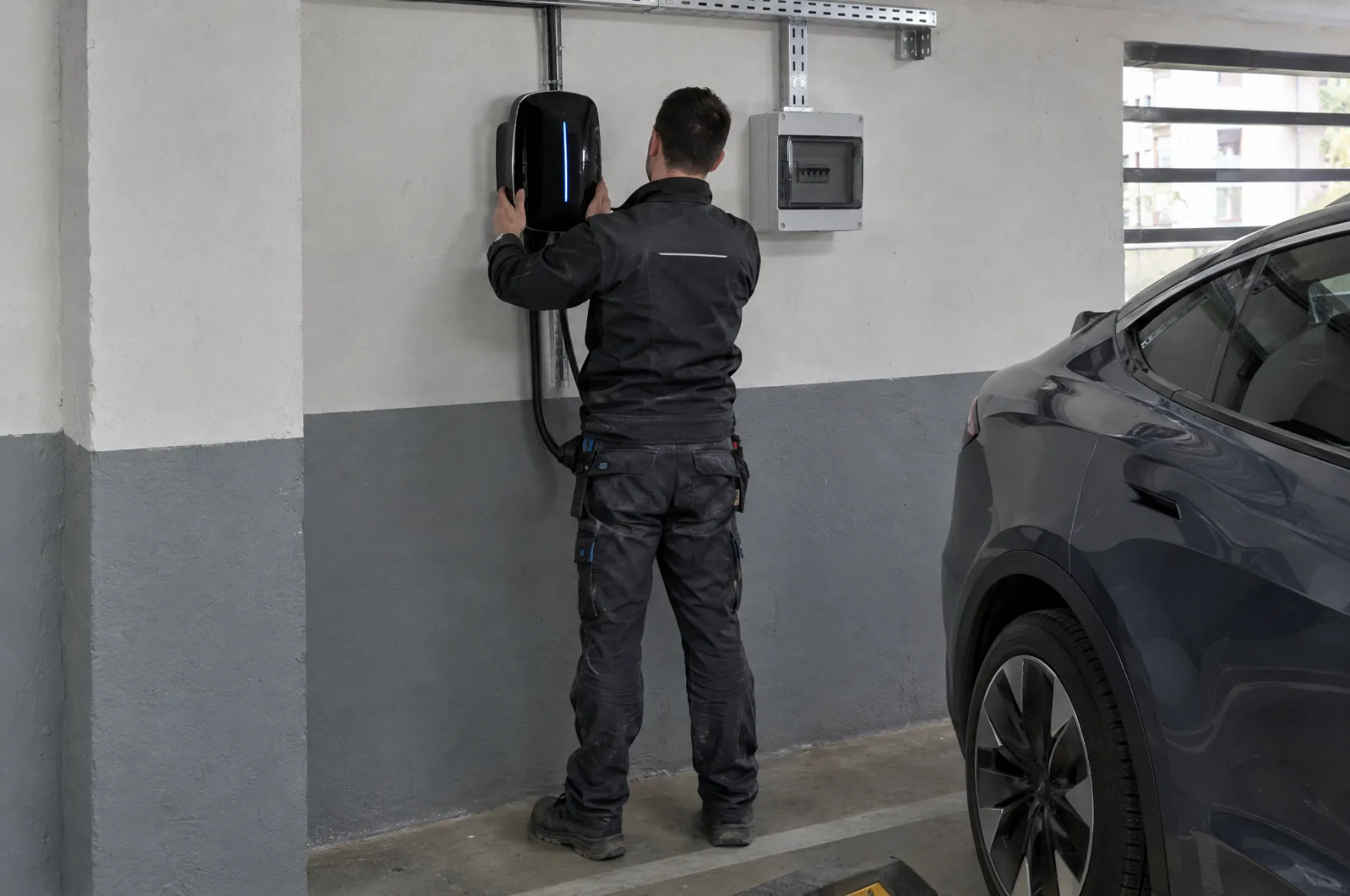
An electric car charges most cheaply and conveniently at night, at the spot where it is parked anyway. So buying an electric car starts with the question of where you will charge it, not with the color and trim.
Below is a checklist you go through yourself, with the building manager and a licensed electrician.
See what your spot allows technically on the page check your garage.
The spot: where the car stands every night
Home charging makes sense when the car stands at the same spot every night: in your garage, a garage box, a yard or your space in a shared garage. If you park on the street wherever you find room, home charging is hard to set up.
Write down whether the spot is yours, rented or part of a shared garage. That decides whose consent you need. Also note how far the spot is from the distribution board, because the length of the route affects the scope of the work.
Don’t plan to charge every day from an ordinary household socket. ADAC does not recommend it for safety reasons alone. In its 2026 test, charging losses were 12.7–24.2% at the socket and 5.1–7.0% at the wallbox.
Power: what the car accepts and what your connection gives
A car accepts as much AC power as its on-board charger allows. In the technical data, find the AC charging power in kW and the number of phases. For popular models the figures are on the page a home charger by car.
An 11 kW wallbox charges on three phases, so a car with a single-phase charger won’t take more than its own limit even there. Why 11 kW or less is usually enough overnight is explained in the guide an 11 or 22 kW charger.
The other side is your connection. Approved power (odobrena snaga) is the power the distribution system operator has approved for your metering point. It can be increased if the technical conditions allow. Check the figure on your electricity bill.
A licensed electrician assesses whether a charger fits overnight within the power you already have. If it doesn’t, the request for more power goes to Elektrodistribucija, and more power also means a higher monthly cost. The procedure is described in the guide on increasing your power with EDS.
The building: when you need an assembly decision
If the charger or the cable runs through the building’s common areas, ask the building manager whether you need a decision of the residents’ assembly (skupština stambene zajednice). Under the Law on Housing and Building Maintenance, the assembly decides on placing things in the common areas and on the fee their owners pay (Article 42).
As a rule, the assembly decides by a simple majority of the members present (Article 44). For disposing of common areas the law requires 2/3 of all votes, and the owners’ rules can set the majorities differently. Ask a lawyer which majority applies to your case.
A meeting needs a quorum: a simple majority of all votes (Article 45). Without it, a repeated meeting is held no sooner than three and no later than 30 days later, and its quorum is one third of the votes. The notice of a meeting must be posted at least three days in advance (Article 43).
Come to the meeting with a clear proposal: where the charger goes, where the cable runs and how your consumption is metered. Neighbors decide more easily when they see that a separate MID meter measures only your electricity. The meeting is run by the manager and the residents, and the outcome of the vote depends neither on you nor on the contractor. Document templates are on the page assembly templates.
Timelines: from the idea to the first charge
A house with its own connection takes the shorter path: an on-site assessment, a request for more power if needed, then the installation. The installation itself takes one working day.
In an apartment building add the proposal, the meeting and, without a quorum, a repeated meeting. When an assembly decision is needed, count on 4–10 weeks in total. If the car arrives before the charger, you will spend the first weeks without home charging, so start the check before you sign.
Electricity: the night tariff and consumption zones
You get the lower tariff only with a two-tariff meter. The lower tariff lasts eight hours: in Belgrade from midnight to 8, in Vojvodina from 23 to 7, and in central Serbia from 22 to 6.
Under the EPS price list in effect since October 1, 2025, a kWh at the lower tariff costs a quarter of the higher tariff in the same zone. With all fees and taxes, a night kWh in the blue zone comes to about 6 RSD.
The zone depends on the household’s total monthly consumption. The green zone runs up to 350 kWh, the blue one up to 1,200 kWh, and above that is the red zone. A car easily moves a household from the green zone into the blue one. Prices can change, so check the current price list before you calculate. What that means for your mileage is in the guide how much a car adds to your power bill.
Checklist before you sign for the car
- The car stands at the same spot at night, and you know whether the spot is yours, rented or shared.
- You know the car’s AC charging power in kW and how many phases it uses.
- You know the approved power of your metering point and whether you have a two-tariff meter.
- A licensed electrician has looked at the distribution board and the cable route to the spot.
- The manager has told you whether the building has owners’ rules and when the next meeting is.
- A lawyer has told you which majority applies to your case.
- You have compared the car’s delivery date with the time needed for the decision and the installation.
Once you are through the list, what remains is the equipment and the installation. Evolako START is a heavy-duty socket with a MID meter, 2.3–3.7 kW, for 39,000 RSD. The 11 kW WALLBOX starts at 94,000 RSD, or 104,000 RSD with a MID meter. For several spaces in a building, the ZGRADA package starts at 96,000 RSD per space. All the packages are on the page packages and prices.
Sources
- Law on Housing and Building Maintenance (Official Gazette of RS 104/2016 and 9/2020), Arts. 42–45
- EPS — basic terms, approved power of a metering point
- EPS — price list in effect from October 1, 2025
- Danas — new electricity price list by tariff and zone from October 1, 2025
- N1 — How to know when electricity is cheap, 19.08.2026
- ADAC — study of charging losses on a socket and a wallbox, 06.08.2026
This guide was written with the help of AI tools based on the sources listed and was last checked on November 17, 2026. If you spot an error or have newer data, let us know at hello@evolako.com — we publish corrections with a date.
Check the spot before the car arrives
Evolako START is a heavy-duty socket with a MID meter, 2.3–3.7 kW and up to about 180 km in one night, for 39,000 RSD (final price). The site check is 2,990 RSD and counts toward the installation price.
Read next
Home charging for apartment residents — installation, MID meter and billing down to the dinar.
The iPhone and Android app is coming soon.
Let me know when it’s out →
ANDREI SMEKHOV PR NOVI SAD · Katolička porta 6/3, 21000 Novi Sad · Reg. no. 68853834 · Tax ID 116047038 · Accessibility